How Supervisors Can Check In With Workers Without Crossing the Line
Supervisors are responsible for a lot on a jobsite.
Production, schedules, quality, equipment, crews, subcontractors, changing conditions, and most importantly, safety.
But what happens when the potential safety concern is not a piece of equipment or a physical hazard?
What happens when it is a worker who does not seem like themselves?
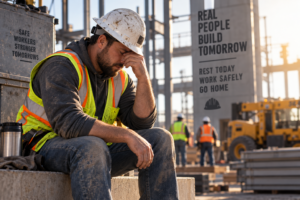
Maybe they are unusually quiet. Maybe their work quality has changed. Maybe they are frustrated, exhausted, distracted, or making mistakes they normally would not make.
This is where many supervisors hesitate.
They may see that something is wrong but think, “I’m not a counselor. What am I supposed to say?”
The answer is not to become a counselor. A supervisor’s job is not to diagnose someone’s mental health or solve their personal problems.
The job is to recognize when something may be affecting safety, have a respectful conversation, and help connect that worker with the appropriate support when necessary.
Supervisors Set the Tone
Workers pay attention to how supervisors respond when someone raises a concern.
If every concern is laughed off, ignored, or treated like weakness, workers learn quickly to keep things to themselves.
That becomes a safety problem.
A worker who is exhausted, overwhelmed, or distracted may continue performing a high-risk task because they do not feel comfortable saying anything.
On the other hand, a supervisor who takes concerns seriously can help create an environment where workers speak up before something turns into an incident.
That does not require a long conversation.
Sometimes it starts with simply asking, “Are you doing okay today?”
Pay Attention to Changes
Supervisors work with their crews every day, which means they may be some of the first people to notice when someone’s behavior changes.
Maybe a normally dependable worker suddenly starts showing up late.
Maybe someone who is usually engaged becomes withdrawn.
You might notice repeated mistakes, unsafe decisions, visible exhaustion, unusual anger, trouble concentrating, or difficulty following instructions.
It is important not to jump to conclusions.
One bad day does not mean someone has a mental health condition, and supervisors should not try to diagnose what is happening.
Focus on what you can actually observe.
If that behavior could affect the worker’s safety or the safety of the crew, it is appropriate to check in.
What Do You Actually Say?
The conversation does not need to be complicated.
Start with what you noticed.
“I noticed you seem more distracted than usual today. Are you doing okay?”
Then give the worker an opportunity to answer.
If they tell you something is going on, listen.
You do not have to immediately fix the problem. You also do not need to ask for every detail about what is happening in their personal life.
Bring the conversation back to safety.
“Is this affecting your ability to work safely today?”
That question gives both the supervisor and worker something practical to address.
Maybe the worker needs a few minutes away from the task. Maybe a high-risk activity should be reassigned temporarily. Maybe the employee needs to contact HR, an Employee Assistance Program, their health provider, union representative, or another available resource.
The right response will depend on the situation and the company’s policies.
The important part is that the conversation happened.
Know Where the Line Is
Supporting workers does not mean supervisors need to become mental health professionals.
There are boundaries.
Do not diagnose someone. Do not pressure an employee into sharing private medical or personal information. Do not make promises about confidentiality that you may not be able to keep, especially when someone’s immediate safety may be at risk.
Do not embarrass or shame someone in front of the crew.
And never ignore a serious statement about self-harm, suicide, or harming another person.
Supervisors should know their company’s procedures before those situations happen.
Just like an emergency response plan for a fire, injury, or severe weather event, knowing who to contact and what steps to follow makes it easier to respond appropriately when something serious occurs.
When a Situation Becomes an Emergency
There is a major difference between a worker having a difficult day and someone who may be in immediate danger.
Comments about suicide or self-harm should always be taken seriously.
If there is an immediate danger, follow the company’s emergency procedures and contact emergency services when necessary.
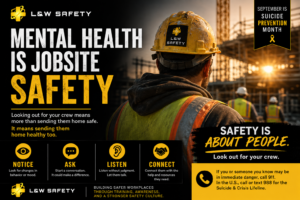
In the United States, the 988 Suicide & Crisis Lifeline is available by calling or texting 988.
Supervisors should not try to handle a crisis alone.
Know who needs to be contacted within the company and what resources are available to employees before an emergency happens.
Safety Starts With People
We spend a lot of time talking about equipment, PPE, procedures, inspections, and compliance.
All of those things matter.
But people are the ones performing the work.
A strong safety culture recognizes when something may be affecting a worker’s ability to perform that work safely.
Checking in with someone does not make a supervisor a therapist. It makes them a supervisor who is paying attention.
Sometimes a two-minute conversation is all it takes to recognize a problem before it becomes an incident.
LW Safety, LLC believes strong safety leadership starts with people. We work with employers to develop practical training, toolbox talks, safety procedures, and programs that help supervisors and employees recognize hazards, communicate concerns, and make safer decisions on the job. Because at the end of the day, safety is about making sure everyone goes home.