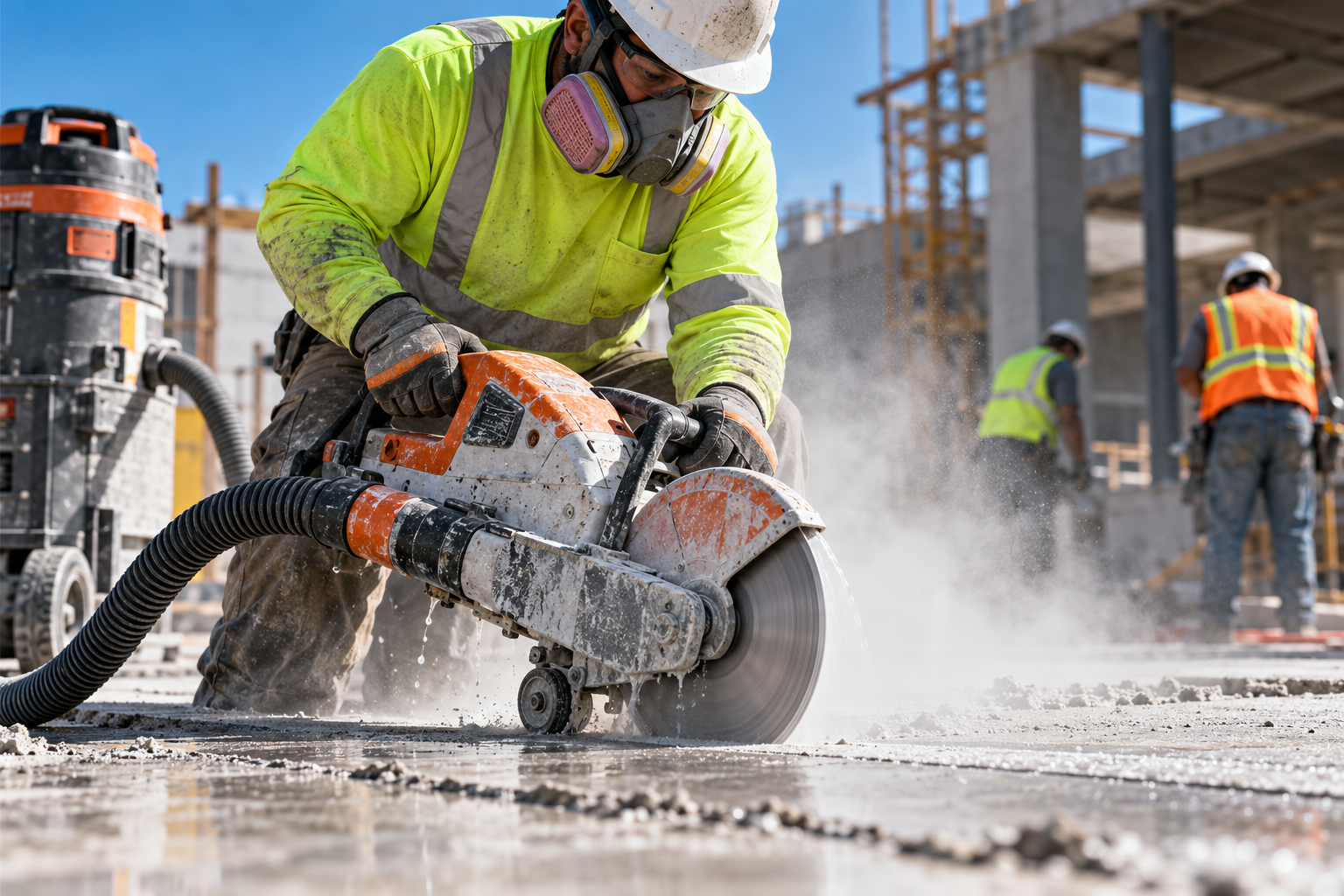
Silica Dust on Jobsites: Protecting Workers During Cutting, Grinding, and Demolition
Concrete cutting. Drilling. Grinding. Demolition. Masonry work.
These are everyday activities on construction jobsites, but they can create a serious health hazard that is easy to overlook: respirable crystalline silica.
Silica is found in materials such as concrete, mortar, brick, stone, tile, and engineered stone. When those materials are cut, drilled, crushed, or ground, extremely small particles can become airborne.
Workers can breathe those particles deep into their lungs.
For contractors and employers, controlling silica should be part of planning the work, not something addressed after the dust is already in the air.
What Is Respirable Crystalline Silica?
Crystalline silica is a common mineral found in many construction materials.
The biggest concern is not necessarily the dust you can see.
Respirable crystalline silica particles can be extremely small. They may remain airborne and can be inhaled deep into the lungs.
Repeated exposure can contribute to serious illnesses, including silicosis, chronic obstructive pulmonary disease, kidney disease, and lung cancer.
Under OSHA’s construction silica standard, the permissible exposure limit is 50 micrograms per cubic meter of air averaged over an eight-hour workday. The action level is 25 micrograms per cubic meter as an eight-hour time-weighted average.
For the crew in the field, the takeaway is straightforward:
If you are creating dust from concrete, stone, masonry, or similar materials, silica exposure needs to be considered.
Know Which Tasks Create Dust
Silica exposure can occur during many common construction activities, including:
- Cutting concrete, brick, pavers, block, or tile
- Grinding concrete floors and surfaces
- Drilling into walls, slabs, and foundations
- Demolishing concrete, mortar, brick, or stone
- Jackhammering and chipping
- Sanding silica-containing materials
- Mixing certain dry materials
- Fabricating or installing stone products
- Cleaning concrete and masonry debris
And remember, the person holding the tool is not necessarily the only person being exposed.
Dust can move into surrounding work areas and affect laborers, electricians, plumbers, inspectors, and other trades.
Silica control needs to account for everyone who could be exposed.
Control Dust Where It Starts
The best time to control silica dust is before it becomes airborne.
Respirators can play an important role, but they should not automatically become the first solution.
Engineering and work-practice controls can reduce the amount of dust workers are exposed to in the first place.
Two common approaches are wet methods and local exhaust ventilation.
Wet Methods
Wet cutting, drilling, and similar systems apply water directly to the point where the tool contacts the material.
Before beginning work, verify that:
- The tool is designed for wet operation.
- The water supply is adequate.
- Water is reaching the point where dust is being generated.
- Electrical hazards have been considered.
- Slurry and runoff can be managed safely.
Simply having water nearby is not the same as effectively controlling dust.
Local Exhaust Ventilation
Another option is capturing dust at the source with a shroud and properly equipped vacuum system.
This only works when the system is set up and maintained correctly.
A damaged shroud, clogged filter, leaking hose, poor connection, or weak vacuum can dramatically reduce its effectiveness.
The goal is not to have a vacuum sitting beside the worker.
The goal is to capture the dust before someone breathes it.
Do Not Create Another Hazard During Cleanup
The cutting may be finished, but the silica hazard may not be.
Dry sweeping concrete or masonry dust can put fine particles right back into the air. Compressed air can do the same thing and spread contamination across an even larger area.
Appropriate cleanup methods may include:
- HEPA-filtered vacuums
- Wet cleanup methods
- Procedures that minimize airborne dust
- Controlled disposal of collected dust and debris
Housekeeping is part of exposure control.
How the crew cleans the area matters just as much as how the work was performed.
Match the Controls to the Task
Not every silica-generating task looks the same.
Before work begins, supervisors should ask:
- What material are we working with?
- What tool are we using?
- How long will the task take?
- Can we use a wet method?
- Can we use local exhaust ventilation?
- Are we working indoors or outdoors?
- Is ventilation limited?
- Could nearby workers be exposed?
- What does OSHA’s Table 1 require for this task?
- Will respiratory protection be required?
A quick outdoor cut and several hours of indoor grinding are different exposure situations.
The controls should match the actual task.
Have a Written Exposure-Control Plan
Where required under OSHA’s silica standard, a written exposure-control plan turns safety expectations into a process crews and supervisors can follow.
The plan should address:
- Tasks that may expose workers to silica
- Engineering controls for those tasks
- Required work practices
- Housekeeping procedures
- Respiratory-protection requirements
- Procedures for limiting access to affected areas
- Employee training
- The competent person responsible for implementing the plan
Most importantly, the plan needs to work in the field.
A safety program that nobody understands or uses is not accomplishing its purpose.
Give the Competent Person the Authority to Act
Under OSHA’s construction silica standard, the competent person needs the knowledge and ability to identify existing and foreseeable silica hazards and authorization to take prompt corrective measures.
That means being able to look at the job and determine:
- Is the correct dust-control system being used?
- Is the equipment working?
- Are workers using the controls correctly?
- Are nearby employees protected?
- Does the work area need to be restricted?
- Are cleanup practices appropriate?
- Have conditions changed?
If a control system fails, the answer should not be to keep working and deal with it later.
Correct the problem before continuing the task.
Respirators Are Part of a Program
There are situations where respiratory protection may be necessary.
But handing someone a respirator does not automatically solve a silica problem.
When respirators are required, employers may need to address:
- Medical evaluations
- Fit testing
- Employee training
- Proper respirator selection
- Inspection
- Cleaning
- Storage
- Replacement
Workers also need to understand the limitations of the equipment they are using.
The right respirator, worn incorrectly, can still leave someone unprotected.
Train Workers on What They Actually Do
Silica training should connect directly to the employee’s work.
Workers should understand:
- Which materials may contain silica
- Which tasks create exposure
- How their dust-control equipment works
- How to recognize when a control is failing
- When respiratory protection is required
- Why certain cleanup methods can increase exposure
- Who to notify when something is wrong
- How their work could expose nearby employees
A short conversation before cutting or grinding begins can prevent a much larger problem.
Review the task. Check the equipment. Establish the work area. Make sure everyone understands the controls.
Then start the work.
Quick Silica Safety Check
Before silica-generating work begins:
- Evaluate the material and task.
- Determine the applicable OSHA requirements.
- Select the proper dust-control method.
- Inspect tools, shrouds, hoses, and vacuums.
- Verify water or vacuum systems are working.
- Protect nearby employees.
- Plan how the area will be cleaned.
- Confirm workers understand the controls.
- Provide respiratory protection when required.
- Have the competent person verify the setup.
Protect Workers Before the Dust Becomes the Problem
Silica-related illnesses can develop over time, which can make the hazard easy to underestimate.
That does not make the exposure less serious.
Effective silica safety comes down to planning the task, controlling dust where it starts, training employees, maintaining equipment, and correcting problems when they are identified.
L&W Safety, LLC helps employers and contractors strengthen safety programs, train employees, conduct hazard assessments, and develop practical controls that work in real jobsite conditions.
If your crews cut, grind, drill, demolish, fabricate, or work around concrete and masonry materials, silica control needs to be part of the job before the tool ever starts.
Safety requirements can vary by industry, jurisdiction, and state. Employers should review the OSHA standards and any state or local requirements that apply to their operations.