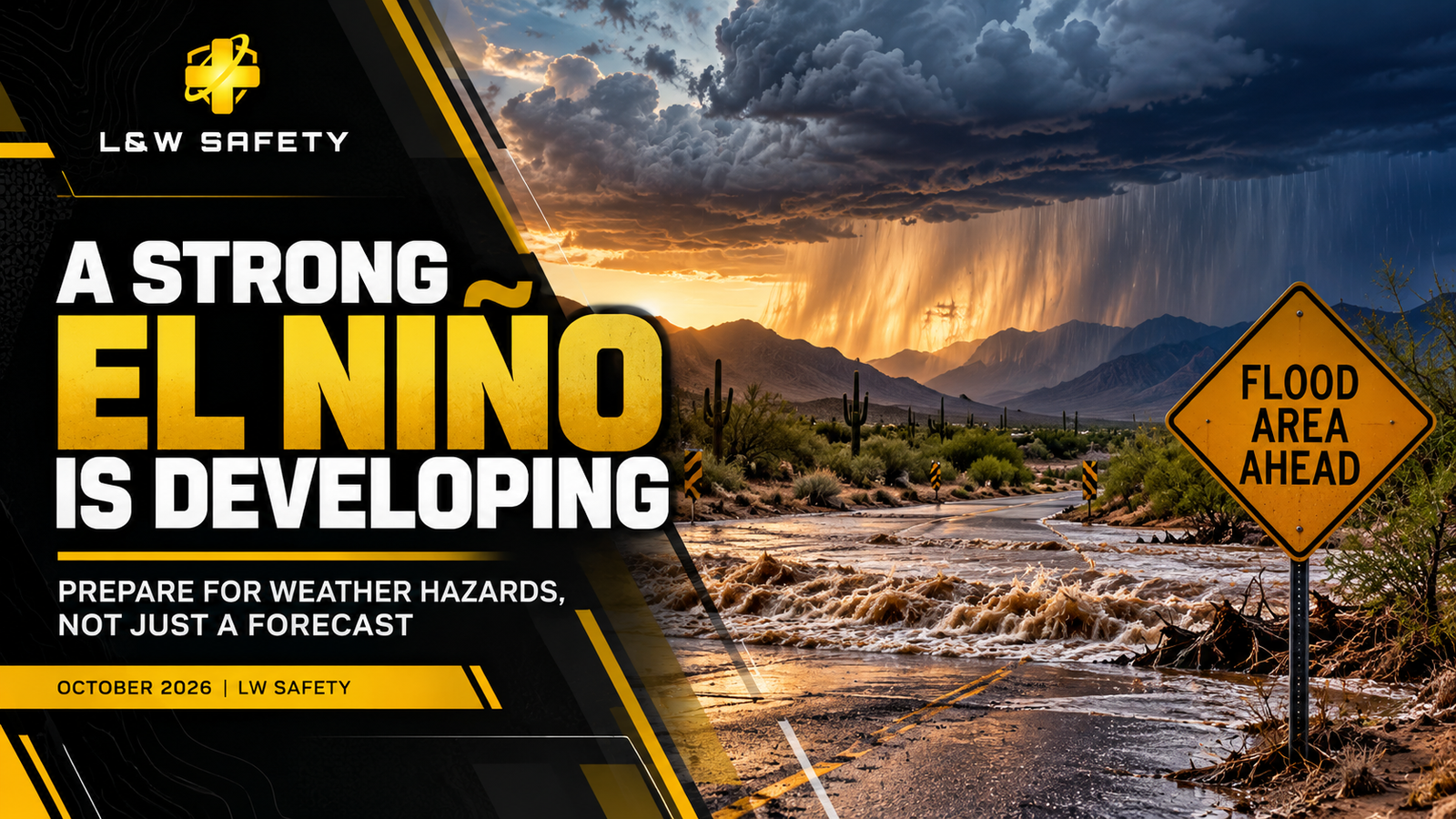
A Strong El Niño Is Developing: Prepare for Weather Hazards, Not Just a Forecast
October 2026 | LW Safety
El Niño is strengthening as we move further into fall, and current forecasts indicate that it could become a very strong event during the fall and winter of 2026–27.
For employers and workers across the Southwest, headlines about a strong El Niño can make it sound as though severe storms and flooding are guaranteed. That is not necessarily the case.
Seasonal forecasts tell us that certain weather patterns may become more likely, but they cannot tell us exactly when or where a damaging storm will occur. For workplaces, the important part of the forecast is not trying to predict the next storm. It is recognizing the potential hazards and preparing for them before conditions become dangerous.
Why This Matters
Heavy rain and flooding can affect a workplace in several ways.
Employees may have to travel through areas with low-water crossings or normally dry washes. Outdoor jobsites can become inaccessible. Facilities may experience drainage problems, electrical hazards, roof leaks, or standing water. Roads that employees regularly use may suddenly become unsafe.
In Arizona and other parts of the Southwest, flash flooding deserves particular attention. Heavy rain does not necessarily have to fall directly over a workplace to create a hazard. Runoff from storms farther away can travel downstream and quickly fill washes and low-lying areas.
That means a clear sky above the jobsite does not always mean there is no flood risk nearby.
What Employers and Supervisors Can Do
Before severe weather arrives, employers should review how weather-related emergencies will be handled.
Start by identifying areas around the workplace and along commonly traveled routes that may be vulnerable to flooding. Employees who regularly drive between locations should know which roads, washes, and low-water crossings present additional risks and whether alternate routes are available.
Emergency plans should also clearly identify who has the authority to stop work, delay travel, close a facility, or order an evacuation.
Employees should not have to guess who makes that decision when conditions begin deteriorating.
Supervisors should also make sure employees understand how emergency information will be communicated. This may include phone calls, text messages, workplace notification systems, weather alerts, or other established communication methods.
If evacuation becomes necessary, workers should know where to go, which routes to use, and how employees, contractors, and visitors will be accounted for.
Most importantly, employees should understand that safety comes before schedules and production.
If a road is flooded, a jobsite is unsafe, or conditions make travel dangerous, workers should have the authority to stop and make a safer decision.
What Workers Should Know
Never drive through a flooded roadway or around a barricade.
Floodwater can be deeper and faster than it appears, and the roadway underneath may have been damaged or completely washed away. What looks like a shallow crossing can become dangerous very quickly.
Workers should also pay attention to local weather alerts rather than relying only on seasonal forecasts or general weather information.
A seasonal El Niño forecast provides a broad picture of what conditions may be like over several months. Local watches and warnings provide the information needed to make immediate safety decisions.
If a flash flood warning is issued for your area, follow emergency instructions and move away from washes, low-lying areas, and other locations vulnerable to flooding.
Do Not Forget About Hazards After the Storm
The end of the rain does not necessarily mean the end of the danger.
Floodwater can leave behind damaged electrical systems, unstable structures, debris, contaminated water, damaged roads, and downed power lines.
Before employees enter an affected workplace or jobsite, conditions should be evaluated and hazards identified.
Recovery work should be approached just like any other hazardous task: assess the area first, control the hazards, use the proper equipment, and make sure employees understand the work they are being asked to perform.
Final Thoughts
A strong El Niño forecast should not create panic, and it should not be treated as a guarantee that every community will experience severe weather.
It should create awareness.
Employers have an opportunity now to review emergency procedures, inspect facilities, identify vulnerable travel routes, and talk with employees about what they should do when severe weather occurs.
The best time to decide how your workplace will respond to flooding or severe weather is not when the warning appears on someone’s phone.
It is before the storm arrives.
Prepare early. Communicate clearly. Monitor local conditions. And never allow a deadline or production schedule to become more important than getting your employees home safely.
Sources
National Oceanic and Atmospheric Administration (NOAA), Climate Prediction Center
National Weather Service
Occupational Safety and Health Administration (OSHA)
USDA Climate Hubs
At LW Safety, we believe preparation is one of the most effective ways to protect your workforce. Reviewing emergency plans, communicating expectations, and preparing for changing weather conditions before they arrive can help keep employees safe when it matters most. Safety starts with awareness, and preparation starts before the storm.