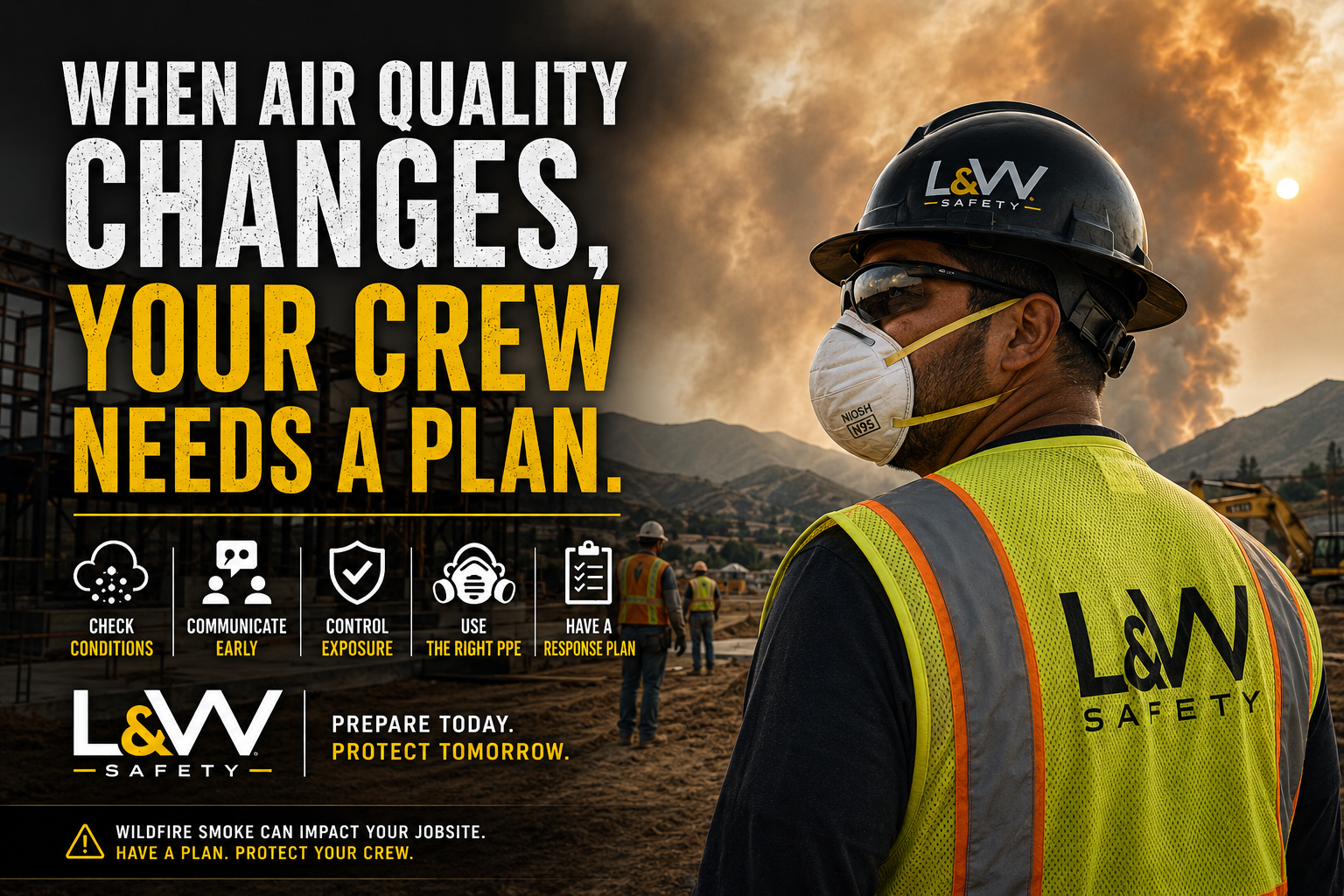
Wildfire Smoke and Outdoor Construction: When Air Quality Changes, Your Crew Needs a Plan
In Southern California, wildfire smoke can move into a work area quickly.
A construction crew may begin the morning under clear skies, only to find visibility dropping and smoke settling into the area later in the shift. When that happens, safety decisions cannot begin with, “What do we do now?”
The plan needs to already be in place.
For employers with crews working outdoors, wildfire smoke is more than an inconvenience. It can become a serious occupational health hazard, and California employers have specific responsibilities for protecting workers when wildfire smoke affects air quality.
Why Wildfire Smoke Matters on the Jobsite
One of the primary hazards associated with wildfire smoke is PM2.5, extremely small airborne particles that can travel deep into the lungs.
Exposure can cause coughing, wheezing, difficulty breathing and reduced lung function. It can also worsen existing respiratory and cardiovascular conditions.
For construction workers, the concern can become even greater because many tasks involve physical labor. The harder someone works, the faster and deeper they breathe, potentially increasing their exposure.
That means wildfire smoke needs to be treated like any other changing jobsite hazard: identify it, communicate it and control the exposure.
Know the Number: AQI 151
Under California’s Protection from Wildfire Smoke standard, employers need to pay particular attention to the current Air Quality Index for PM2.5.
When the current AQI for PM2.5 reaches 151 or greater, Cal/OSHA’s wildfire smoke requirements apply to most covered workplaces where employers should reasonably anticipate workers may be exposed to wildfire smoke.
But checking the AQI once in the morning isn’t necessarily enough.
Conditions can change during a shift.
Wind direction can change. Smoke from a distant wildfire can move into the area. A jobsite that was acceptable at 7:00 a.m. may look very different by noon.
That’s why a good wildfire smoke plan needs to answer a simple question:
What happens when the air quality changes during the shift?
Build a Field Response Plan Before You Need It
Every supervisor and crew should understand what happens when smoke begins affecting the jobsite.
A practical response plan should establish who is responsible for monitoring air quality, how workers will be notified when conditions change, where respirators are located, what alternative work locations are available and who has the authority to modify or stop work when necessary.
There should be no confusion in the field.
When conditions change, workers shouldn’t have to track down a manager, search for PPE or guess whether they should continue working.
The response should already be understood.
Communication Is Part of the Control
Cal/OSHA requires employers covered by the wildfire smoke standard to have a system for communicating wildfire smoke hazards in a language and manner employees can readily understand.
That communication needs to work both ways.
Supervisors should be able to communicate current air-quality conditions and available protective measures to employees. Workers should also be encouraged to report worsening conditions or symptoms they believe may be related to smoke exposure.
That last part matters.
The people working outside may notice changing conditions before someone sitting in an office does.
A strong safety culture gives workers a clear way to speak up when something changes.
Control the Exposure, Don’t Just Hand Out Masks
Respirators are important, but wildfire smoke protection shouldn’t begin and end with an N95.
When feasible, employers should first look at ways to reduce exposure. That can include moving employees into enclosed areas or vehicles with filtered air.
When those controls aren’t enough or aren’t feasible, administrative changes can also help. Depending on the operation, that could mean relocating work, adjusting schedules, reducing work intensity or providing additional rest periods.
Respiratory protection becomes another layer of that strategy.
When the current AQI for PM2.5 is 151 through 500, covered employers must provide enough NIOSH-approved particulate respirators, such as N95 filtering facepiece respirators, for employees to use voluntarily and encourage their use.
When the current AQI for PM2.5 exceeds 500, respirator use becomes mandatory and additional respiratory-protection requirements apply.
A bandana, T-shirt or ordinary face covering is not a substitute for an approved particulate respirator.
Train Before the Smoke Arrives
Wildfire smoke training should not happen for the first time while a crew is standing in smoke.
Workers and supervisors should already understand:
- how wildfire smoke can affect their health;
- how the AQI and PM2.5 relate to their work;
- how the company monitors changing conditions;
- what controls will be used to reduce exposure;
- when respirators are available or required;
- how to properly use a respirator; and
- how to report worsening air quality or symptoms.
This turns wildfire smoke response from an improvised decision into part of normal jobsite planning.
Safety Is About Being Ready for What Changes
Construction work is constantly changing.
Weather changes. Equipment changes. Crews move. Site conditions change.
Air quality is no different.
The goal isn’t to wait until smoke becomes thick enough for everyone to notice. The goal is to recognize the hazard early and already know what happens next.
Check the conditions. Communicate with the crew. Control the exposure. Have the equipment ready. And give supervisors a clear response plan.
Because when the air quality changes during the shift, the crew shouldn’t be asking what the plan is.
They should already know.
L&W Safety
At L&W Safety, we believe effective safety programs have to work where the work actually happens — in the field.
From workplace safety training and compliance support to helping organizations build stronger safety practices, our focus is giving employers and employees the knowledge they need to recognize hazards, respond appropriately and get home safely.
Safety isn’t just a requirement. It’s preparation.
This article is intended for general safety education and does not replace applicable Cal/OSHA regulations, site-specific hazard assessments, or professional safety guidance.